Showing posts with label Sports Car. Show all posts

2011 Lotus Car Wallpaper

Really I feel so proud after having this awesome 2011 Lotus Car. This car is a beauty car that ever built. The design concept is fairly different from any other cars.

 - Lotus Cars » Blog Archive » 2011 lotus elise for sale
 - Geneva 2010: Lotus Elise Gets Sharpened Look for 2011 - LotusTalk ......
 - Lotus Cars » Blog Archive » 2011 lotus elise price
 - 2011 Lotus Elise Photo Car and Driver - (
2011 Lotus Elise Photo Car and Driver
 - 2011 Lotus Elise | Latest Cars And Bikes Reviews
2011 Lotus Elise | Latest Cars And Bikes Reviews
 - 2011 Lotus New Esprit Sports Car - Cars, Concept & Design

2011 New Mercedes E-Class Cabriolet includes

The highly appealing and emotionally charged Mercedes-Benz E-Class Cabriolet is the latest addition to the successful E-Class line-up. The open-top two-door model, which went on sale on 11 January 2010, features a classic fabric soft top, making for a stylistically pure cabriolet feeling. Viewed from the side, the new model is an intriguing proposition - with its clear proportions and a flawless cabriolet silhouette.
2011 New Mercedes E-Class Cabriolet
In keeping with the motto "four seasons, four personalities", all-year-round suitability was right at the top of the developers' list of priorities. With the new E-Class Cabriolet, the cabriolet season lasts the whole year because, while many cabriolets tend to disappear from the roads of Western Europe in the autumn, the Mercedes-Benz E-Class Cabriolet (length/breadth/height: 4698/1786/1402 mm) provides driving pleasure and comfort whether the roof is open or closed.
2011 New Mercedes E-Class Cabriolet
The soft top can be opened and closed fully automatically within 20 seconds - even when driving at speeds of up to 40 km/h. The cabriolet roof is stowed in a special compartment behind the rear panel. A retractable cover separates the soft top compartment from the boot area; it must be closed in order to close the soft top. If the roof is to remain closed, the cover can be slid rearwards, in which case the boot capacity is increased by 90 litres to 390 litres. A through-loading feature is included as standard for the new Cabriolet, as is EASY-ENTRY - a manually operated entry and exit aid for the rear passengers.
2011 New Mercedes E-Class Cabriolet
The powerplants for the new Mercedes-Benz E-Class Cabriolet are equally innovative: the new direct-injection diesel and petrol models combine efficiency with effortlessly superior power delivery. The exemplary, low fuel consumption has not only been achieved because of the new engines, but also with a number of practical measures. These include on-demand activation of the steering and fuel pumps, the use of tyres with low rolling resistance and an alternator control system which takes account of the current driving situation and the vehicle's electrical power requirements, plus the crucial factor of outstanding aerodynamics. The Cabriolet's cd figure of 0.28 is the best in its class, marking a continuation of the Mercedes-Benz E-Class success story in the field of aerodynamics.
2011 New Mercedes E-Class Cabriolet
In 1989, Mercedes-Benz introduced a world premiere in the shape of a draught-stop for the Mercedes-Benz SL-Class, followed in 2004 by the AIRSCARF® neck-level heating system to further enhance comfort in open-top models. Now comes another world-first: the AIRCAP® automatic draught-stop, which can be activated at the push of a button, greatly reduces turbulence in the interior of the new Mercedes E-Class Cabriolet, creating a sea of warm air. It is also much easier to implement and use than conventional draught-stops: there is no tricky installation, the two individual rear seats remain free and the Cabriolet's flowing side lines remain uninterrupted. AIRCAP® is therefore a classic Mercedes innovation: functional, comfort-enhancing, elegant and safe.
2011 New Mercedes E-Class Cabriolet
AIRCAP® consists of two components: a wind deflector that can be extended by around six centimetres with a net in the windscreen frame and a draught-stop between the rear seats.
2011 New Mercedes E-Class Cabriolet
As well as enhancing occupant comfort and wellbeing, the reduction in draught when AIRCAP® is activated (it can be activated at speeds of up to 160 km/h and remains in use right up to the car's top speed) reduces the interior noise level - so passengers in all seats find it far easier to communicate.
2011 New Mercedes E-Class Cabriolet
The Cabriolet Comfort package includes AIRCAP® with AIRSCARF®. This patented system functions like an invisible scarf, which warms the occupants' head and neck areas. AIRSCARF® is integrated into the backrests of the front seats and provides warm air through outlets in the head restraints.
2011 New Mercedes E-Class Cabriolet
The Mercedes engineers have modified this unique innovation specifically for the Mercedes-Benz E-Class Cabriolet: in this model, an adjustment wheel pivots the outlet nozzle upwards and downwards by a total of 36 degrees over and above the head restraint height adjustment, meaning that the driver and front passenger can enjoy the unique neck-level heating regardless of how short or tall they are.

Bugatti Sports Cars Veyron Type 35 Grand Prix Edition

In a highlight on this year’s agenda of centennial celebrations, Bugatti Automobiles S.A.S. presented four Bugatti Veyron specials at Villa d’Este Concorso d’Eleganza. These one off models are reminders of Bugatti’s glorious motor-racing history which played a central role in popularising and ultimately establishing the myth which the brand continues to enjoy to this day.
Bugatti Sports Cars Veyron Type 35 Grand Prix Edition
The Bugatti brand is almost inextricably linked to the Type 35. The Type 35 Grand Prix was by far the most successful racing model. The unmistakable radiator grille and eight-spoke aluminum wheels of the Type 35 have become defining features of the Bugatti automobile. In its day, the Grand Prix was also well ahead of its time in terms of engineering ingenuity.
The front axle design of this vehicle, which, for reasons of weight minimization, is hollow, is a true masterpiece of workmanship and was deemed nothing less than revolutionary. Its springs were passed through the axle to produce a high level of stability. The Grand Prix’s brake drums were integrally fitted into its lightweight aluminum wheels. Unfastening the central wheel nut allowed the wheel to be easily removed within a matter of seconds and the brake to be exposed. This was a crucial advantage at the pit stop.
The blue racers made their first appearance on the race track at the Grand Prix held by Automobil Club de France in Lyon in 1924. In the decade that followed, they remained practically unchallenged thanks to sophisticated manufacturing efforts, their lightweight design and easy handling. During that ten-year era, they won almost 2000 races – more than any other model ever has.
Grand Prix races were highly fashionable events in those days, and Bugatti was not the only brand with considerable interest in substantiating the reputation of its products by winning races. In fact, in the 1920s, Europe was regularly host to a number of different races in different countries on a single weekend. The teams set up by different automobile manufacturers competed at popular race circuits such as Targa Florio, Le Mans, Monza and Spa as well as in Rome, Nice, Antibes and even a village in Alsace.
The main reason Bugatti won such an enormous number of races – on the back of which successes the brand was also able to forge its image – was the fact that Bugatti sold not only its normal sports and touring cars to private buyers, but its racing cars too. Thus it was that its automobiles took part in such a large number of Grand Prix events.
Tradition being what it is, the Bugatti Veyron Specials built to mark the 100th anniversary of the brand feature the racing colors of the respective countries: blue for France, red for Italy, green for England and white for Germany. Each of the four new Veyrons has a specific “predecessor” in the form of an original Grand Prix Bugatti on which it was modelled.
These four historic race cars represent the generation of legendary Bugatti Grand Prix racers which were piloted by world-famous race-car drivers and which scored countless racing victories in the 1920s and ‘30s. Each of the four Veyron Specials is named after a Bugatti race-car driver of the 1920s and 30s. Jean-Pierre Wimille has given the blue Veyron its name, Achille Varzi the red one, Malcolm Campbell the green one and Hermann zu Leiningen the white Veyron.
“We have put a lot of effort into translating colour and material, the defining characteristics of our historic role models, into the designs of the modern-day Veyrons,” explains Alasdair Stewart, Director Sales & Marketing at Bugatti Automobiles S.A.S. “We have taken extreme care to match the original colours of the original race cars, exterior and interior”
On Sunday, the four historic racing Type 35s and the four modern-day Centenaire Edition Veyrons will be exhibited alongside each other in the park of Villa Erba for the first and only time.
Ahead of that presentation, Bugatti will on Saturday be prominently represented in the park of Villa d’Este by a special-display-class exhibition of models, which will serve to portray the 100-year history of the brand. Bugatti’s participation in the classic Concorso d’Eleganza Villa d’Este at Lake Como will be the second highlight event to mark the carmaker’s centennial celebrations after it took part in the International Geneva Motor Show in early March.
This latest event will be followed by the Pebble Beach Concours d’Elegance in California in mid-August and the main celebratory event on 12 September in Molsheim (Alsace), which has been the home of this unparalleled automobile brand for 100 years.

New Seat Sporty Leon Cupra R

Following a very successful debut at the 2009 Frankfurt Motor Show, the new Seat León Cupra R is about to go on sale. Equipped with a new 265 hp engine, it instantly becomes the brand's most powerful production car to date, earning a special chapter in Seat's history in the process.
New Seat León Cupra R
2010 Seat will unveil its most potent series production model to date, the new Leon Cupra R at next month’s Frankfurt Motor Show (all of you may know already because we revealed this fact back in June in this post). The standard model’s 240-horsepower turbocharged 2.0-liter four-pot is replaced with a 265-horsepower direct injection 2.0 TSI. It is unconfirmed if the 2.0 TSI is the same engine found in the Vw Scirocco R.
New Seat León Cupra R
Seat claims however, that the new four-banger features a new, high-pressure fuel pump injector to satisfy its greater performance demands, while fully complying with strict EU5 emissions standards. As a result, the front-wheel drive only Leon Cupra R slashes the 0 to 100km/h (62mph) sprint from 6.4 seconds (standard Cupra) to 6.1 seconds and top speed climbs from 247 km/h (154mph) to 250 km/h (155mph).
New Seat León Cupra R
A be guiling mix of Latin passion and practicality, this new ‘superSEAT’ remains, of course, the rational choice for ultra-hot hatch buyers who want sporty coupé looks allied to five-door functionality.
New Seat León Cupra R
Boasting a thoroughbred sporty engine, the new Seat León Cupra R features exclusive interior and exterior styling touches which reflect its unique character. The Seat León Cupra R is, simply, an attention-grabber. Its feisty exterior design is mirrored on the inside, too, with a motorsport-inspired look and feel that lets you know this is not just another car.
New Seat León Cupra R
The standing kilometer takes 25.7 seconds and it has a combined fuel economy of 8.1 lt / 100km or 29mpg US / 34.9mpg UK. The range-topping Leon gets the ‘R’ logos on the central grille and at the lower right of the hatch, the right instrument dial and the remote control key. In addition, it also receives 19-inch, five double-spoke wheels shod with 235/35 tires.
New Seat León Cupra R
The larger wheel assembly allowed Seat’s engineers to upgrade the braking system with 17-inch 345 x 30 mm discs at the front and 16 inch 286 x 12 mm at the rear. The interior of the Leon Cupra R gets a pair of racing-style bucket seats in grey alcantara upholstery, LED lighting on the instrument dials, a leather multi-functional steering wheel and an aluminum pedal arrangement.
New Seat León Cupra R
The intercooler fitted to the new engine delivers its superior performance through greater turbo pressure. As on the 240 hp version, the engine set-up includes a new, high-pressure fuel injection pump to satisfy its greater performance demands, and the ratios on the six-speed gearbox have been specifically adapted.
New Seat León Cupra R
The extensive, generous equipment list features Seat's impressive new electronic self-blocking XDS system for excellent handling, as well as a broad array of standard features that provide both top notch safety and exceptional on-board comfort. Undeniably, the focal point of the new Seat León Cupra R is its 265 hp direct injection 2.0 TSI engine. Its main characteristics are its tremendous power, easy torque transmission and fabulous flexibility.
New Seat León Cupra R
UK pricing for the new Leon Cupra R is confirmed at £25,205, with orders books opening at dealers nation wide on Thursday 1 April, and the Spanish sports car is Euro 5 compliant as CO2 emission levels are at just 190 g per Km.
New Seat León Cupra R
Welcoming the UK arrival of the brand’s most extreme model to date, SEAT UK Product Marketing Manager Andy Medcraft said: ‘The engineeringand styling revisions that have gone into the new Leon Cupra R under line our determination to make this exceptional new car a tru e class leader.

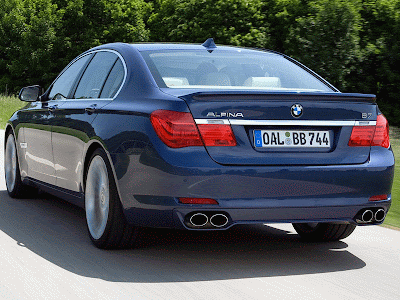
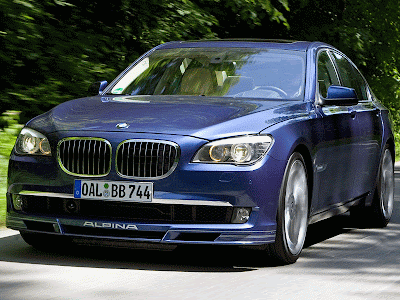
ALPINA B7 BMW luxury Sport Sedan

Both short- and long-wheelbase models will be offered. The BMW ALPINA B7 will make its North American premiere at the 2010 Chicago Auto Show in February, and go on sale at authorized BMW Centers in Spring of 2010. Bmw announced today the prices for the 2011 Alpina B7 for US - $122,875 (standard wheelbase) and $126,775 (extended wheelbase). BMW of North America announced that the BMW ALPINA B7 sedan will join BMW’s North American product range as the most dynamic 7 Series model. The BMW ALPINA B7 represents the second generation of ALPINA automobiles based on the BMW 7 Series to be offered in the US. The first BMW ALPINA B7 was offered as a limited edition for the 2007 and 2008 model years. Newly interpreted and based on the current BMW 7 Series platform, the B7 will again set the benchmark in terms of performance, refinement, technology, luxury and exclusivity. However, Alpina B7 is slightly less powerful that the 760i, but it looks very very sporty and aggressive.
ALPINA B7 BMW luxury Sport Sedan

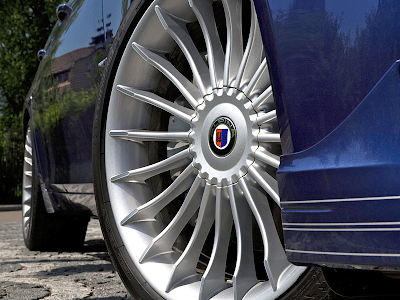
Yielding exquisite levels of power and torque from the twin-turbocharged 4.4 liter V8, and in conjunction with the electronically-adjustable suspension with active roll stabilization, the new B7 promises to offer a spectrum of driving experiences so broad as to be unheard of in this class of automobiles. The evolution of the traditional 20-spoke 21” ALPINA CLASSIC wheels underline the fresh design language found throughout the B7 and impart it a distinctive appearance and powerful stance.
ALPINA – a name famous in Europe and the wider world for putting a particular performance accent on BMWs, though not yet so well-known in North America. BMW – a name famous all over the world for motor vehicles of performance, quality, luxury and safety.
The two companies, both at home in the German state of Bavaria, have a long history of working together to produce special BMW automobiles. Burkard Bovensiepen, son of the founder of ALPINA Business Machines and an enthusastic racing driver/engineer, began his automotive career path in 1961 by developing a dual-carburetor setup for the just-introduced BMW 1500 sedan. It was a predictive beginning: to take an already fine-performing BMW (which also just happened to be a practical sedan) and making it perform even better.
ALPINA B7 BMW luxury Sport Sedan

By 1964, BMW had officially recognized ALPINA’s contribution to BMW performance. Not long thereafter, Burkard Bovensiepen founded the ALPINA company – ALPINA Burkard Bovensiepen KG – that continues today, creating special versions of BMW automobiles that offer a particular brand of performance for discriminating auto enthusiasts. Yet outside the circle of dedicated BMW enthusiasts, ALPINA has kept a low profile in North America. In addition to racing versions of BMWs, ALPINA has developed a progression of BMW-based cars based on 3, 5, 6, 8, Z4 and Z8 models and offered them on a limited-production basis. ALPINA is located in the small Bavarian city of Buchloe, some 50 miles southwest of Munich, BMW’s headquarters city and the capital of Bavaria.
ALPINA B7 BMW luxury Sport Sedan

The B7 is the newest manifestation of the unique BMW-ALPINA synergy – once again based on the BMW 7 Series luxury sedan. Currently, BMW offers ultra-performance models of its 3, 5, 6, X5 and X6 Series developed by BMW M, BMW’s own performance subsidiary. For an ultra-performance version of the 7 Series – a vehicle defined by luxury and generous interior space – something other than “M” performance character was called for. In recent models, ALPINA has concentrated on delivering very high levels of performance with moderate rpm ranges and automatic transmission. Most appropriately, the new BMW ALPINA B7 applies this philosophy to the newest 7 Series to produce a luxury sedan of stunning performance. “A 7 Series Beyond,” one might say.

2010 Touring Superleggera A8GCS Berlinetta Sports Cars Concept

Touring Superleggera A8GCS Berlinetta was revealed in the flesh at the 2010 Geneva Motor Show after being previewed at the Concours d'Elegance. At the Festival Automobile in Paris last month, a panel comprised of designers, car experts and former Formula 1 driver Alain Prost awarded the Maserati A8GCS Berlinetta Touring the most beautiful supercar of the year. Television network Eurosport fielded over one million votes from viewers for the competition. Viewers’ choices included the Bugatti Sport Veyron, BMW 750i and Lotus Evora.
2010 Touring Superleggera A8GCS Berlinetta
Now this is how it's done. The Touring Superleggera A8GCS Berlinetta is a Maserati Gran Turismo rebodied with classic GT proportions and shapes. The result is classically beautiful, like a 1950s Maserati re-interpreted with 21st century technology.
Based on the Maserati Coupé GranSport mechanics, the A8GCS Berlinetta Touring represents the high performance sports car concept, with small dimensions, state-of-the-art constructive technology and perfect stylish synthesis between factory tradition and advanced aesthetic criteria.
Unlike the Bentley Flying Star shooting brake that's also from Touring Superleggera, the Berlinetta isn't destined for a well-heeled car nut. The company created it specifically to showcase its coachbuilding skills. If they have their way, they'll be turning the Maserati Gran Turismo and other exotic cars into vehicles that are even more exclusive, luxurious and personalized.
The new A8GCS Berlinetta Touring has been designed by the young Belgian designer Louis de Fabribeckers, in charge of the Touring styling department. The A8GCS Berlinetta Touring lines are not affected by time or fashion: the car is characterized by a soft aggressiveness originated by the perfect balance between the front end, directly derived from competitions, and the harmonious and fluent flanks reminding of the extraordinary Alfa Romeo, Isotta Fraschini and Lancia Flying Star of the Thirties, an exceptional series created by Touring and still considered the best interpretation of Marinetti and Boccioni’s Futurism.
The Carrozzeria Touring Superleggera style is first expressed through perfecly balanced volumes (reduced front overhang, front central engine and large rear overhang). The result is a dynamic form that doesn’t need a lowered waistline. Moreover, the horizontal development of lines create a natural elegance.
The sporty look of the car is underlined by the combination between bonnet and front grille. An element dashing forward the other volumes. Hence the lateral lines of the body: the lower line ends on the rear wheelarch and the upper line dissolves in the rear end of the car. Together they create a dynamic sail shape, as on Flying Stars.
Of course, also the most successful car design is not enough to make an alive and complete object. It must be combined with excellent dynamic qualities, derived from state-of-the-art technical solutions. For the prototype A8GCS Berlinetta Touring, Carrozzeria Touring Superleggera studied and designeda body in advanced composite materials, able to give the car lightness, structural strenght and performance typical of top granturismo and obviously respecting all international safety and environmental rules. The result is clear: the style protoype A8GCS Berlinetta Touring is able to enter small series production, gaining immediately a top place among the best sports cars.
The A8GCS is a strict two-seater, unlike the car on which it's based which features a 2+2 seating layout. Touring Superleggera have made extensive changes to the car's bodywork while still retaining similar proportions. The styling details like the minimalist chrome trim and classic wire wheels give the car a distinctive retro vibe, while also not being unnecessarily nostalgic.
"We wanted a strong project" - says the Belgian Head of Design of Touring Superleggera, Louis de Fabribeckers - "I drew from the stylistic heritage of Touring the work of surfaces and also this sinusoidal line across the side of the Berlinetta".
The Touring Superleggera A8GCS Berlinetta is 4.2 metres long and only 1.2 metres high. The engineers are aiming for a 1,500 kg (3,307 lb) weight for the finished car - 180 kgs (400 lbs) lighter than the Maserati GranSport.
Related Posts Plugin for WordPress, Blogger...