Find here the development of famous cars in the world. you can find the latest designs, models and matters relating to otomotivnya. how the car companies from different continents that have been known to produce and introduce their products
Showing posts with label Electric Car. Show all posts
Peugeot Leonin – Electric Car
Concept car designer Liviu Tudoran has designed an eco-friendly electric car for Peugeot that complements the Lion image that we see in the car brand’s logo. The car, dubbed the Peugeot Leonin, is based on an electric engine mounted in the back of the car which is powered by a battery supply unit that rests under the front hood.
2011 New Mercedes E-Class Cabriolet includes
The highly appealing and emotionally charged Mercedes-Benz E-Class Cabriolet is the latest addition to the successful E-Class line-up. The open-top two-door model, which went on sale on 11 January 2010, features a classic fabric soft top, making for a stylistically pure cabriolet feeling. Viewed from the side, the new model is an intriguing proposition - with its clear proportions and a flawless cabriolet silhouette.

2011 New Mercedes E-Class Cabriolet
In keeping with the motto "four seasons, four personalities", all-year-round suitability was right at the top of the developers' list of priorities. With the new E-Class Cabriolet, the cabriolet season lasts the whole year because, while many cabriolets tend to disappear from the roads of Western Europe in the autumn, the Mercedes-Benz E-Class Cabriolet (length/breadth/height: 4698/1786/1402 mm) provides driving pleasure and comfort whether the roof is open or closed.

2011 New Mercedes E-Class Cabriolet
The soft top can be opened and closed fully automatically within 20 seconds - even when driving at speeds of up to 40 km/h. The cabriolet roof is stowed in a special compartment behind the rear panel. A retractable cover separates the soft top compartment from the boot area; it must be closed in order to close the soft top. If the roof is to remain closed, the cover can be slid rearwards, in which case the boot capacity is increased by 90 litres to 390 litres. A through-loading feature is included as standard for the new Cabriolet, as is EASY-ENTRY - a manually operated entry and exit aid for the rear passengers.

2011 New Mercedes E-Class Cabriolet
The powerplants for the new Mercedes-Benz E-Class Cabriolet are equally innovative: the new direct-injection diesel and petrol models combine efficiency with effortlessly superior power delivery. The exemplary, low fuel consumption has not only been achieved because of the new engines, but also with a number of practical measures. These include on-demand activation of the steering and fuel pumps, the use of tyres with low rolling resistance and an alternator control system which takes account of the current driving situation and the vehicle's electrical power requirements, plus the crucial factor of outstanding aerodynamics. The Cabriolet's cd figure of 0.28 is the best in its class, marking a continuation of the Mercedes-Benz E-Class success story in the field of aerodynamics.


2011 New Mercedes E-Class Cabriolet
In 1989, Mercedes-Benz introduced a world premiere in the shape of a draught-stop for the Mercedes-Benz SL-Class, followed in 2004 by the AIRSCARF® neck-level heating system to further enhance comfort in open-top models. Now comes another world-first: the AIRCAP® automatic draught-stop, which can be activated at the push of a button, greatly reduces turbulence in the interior of the new Mercedes E-Class Cabriolet, creating a sea of warm air. It is also much easier to implement and use than conventional draught-stops: there is no tricky installation, the two individual rear seats remain free and the Cabriolet's flowing side lines remain uninterrupted. AIRCAP® is therefore a classic Mercedes innovation: functional, comfort-enhancing, elegant and safe.

2011 New Mercedes E-Class Cabriolet
AIRCAP® consists of two components: a wind deflector that can be extended by around six centimetres with a net in the windscreen frame and a draught-stop between the rear seats.

2011 New Mercedes E-Class Cabriolet
As well as enhancing occupant comfort and wellbeing, the reduction in draught when AIRCAP® is activated (it can be activated at speeds of up to 160 km/h and remains in use right up to the car's top speed) reduces the interior noise level - so passengers in all seats find it far easier to communicate.


2011 New Mercedes E-Class Cabriolet
The Cabriolet Comfort package includes AIRCAP® with AIRSCARF®. This patented system functions like an invisible scarf, which warms the occupants' head and neck areas. AIRSCARF® is integrated into the backrests of the front seats and provides warm air through outlets in the head restraints.


2011 New Mercedes E-Class Cabriolet
The Mercedes engineers have modified this unique innovation specifically for the Mercedes-Benz E-Class Cabriolet: in this model, an adjustment wheel pivots the outlet nozzle upwards and downwards by a total of 36 degrees over and above the head restraint height adjustment, meaning that the driver and front passenger can enjoy the unique neck-level heating regardless of how short or tall they are.
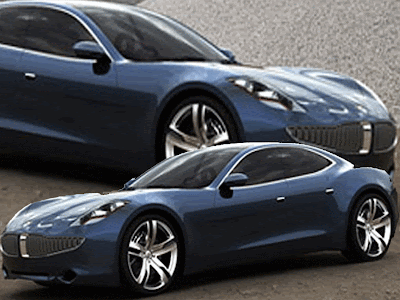
Fisker Karma (2010) Plug-in Hybrid Sports Sedan
At the 2010 Geneva Motor Show, Fisker Automotive are set to reveal their advanced aluminium space frame which is to feature in the stunning Fisker Karma plug-in hybrid electric sports sedan. The Fisker Karma, the world’s first premium plug-in hybrid electric vehicle, will make its Chicago debut at the Chicago Auto Show February 12-21. With the Karma, American automaker Fisker Automotive (www.fiskerautomotive.com) proves that with eco-friendly cars you can enjoy beautiful, distinctive design and thrilling performance with a clear conscience.
Fisker Karma (2010) Plug-in Hybrid
2010 Fisker Karma Preview – 2008 Detroit Auto Show: Just this morning we attended a press conference held by a well-known Italian luxury car company, one that sells fewer than 10,000 cars annually and employs executives who tout the brand’s exclusivity. Maybe they haven’t heard about Fisker Automotive, and in particular, the 2010 Fisker Karma plug-in hybrid.
Despite a projected annual production run of approximately 15,000 units, the Karma comes much closer to the true definition of exclusive thanks the plug-in’s first-to-market status, relatively affordable $80,000 base price, lithium ion battery technology, full-electric range of 50 miles, and a gas/electric fuel economy rating of 100 mpg. That kind of exclusivity will be available from Fisker in late 2009.
The 403hp, four-door Karma plug-in hybrid can go zero to 60mph in six seconds and has a top speed of 125mph, but it can still achieve an annual average of more than 100mpg and drive tailpipe-emission free. Features include a sculpted body, 22-inch wheels, trunk space for two sets of golf clubs, a 10.2-inch haptic touchscreen control center, reclaimed wood trim and an available animal-free interior trim package.
"Our top priorities when we designed the Karma's aluminium space frame were that it have extremely high torsional rigidity and could be easily modified to accept Karma model variants," explained Henrik Fisker, CEO, Fisker Automotive. "We benchmarked some of the world's best cars to create an all-new space frame that will deliver an exhilarating experience behind the wheel." A super-structural tunnel running down the car's centerline acts as the Karma's backbone. The spaceframe is designed around the car's unique Q-DRIVE series-hybrid powertrain.
Behind the rear-drive Karma’s taut skin is a lightweight chassis that places the battery pack in the vehicle’s center to enhance driving dynamics and safety. Fisker says its plug-in hybrid sports sedan will hit 60 mph in 5.8 seconds and travel up to 50 miles on electric power alone; with a supplemental four-cylinder gasoline engine that powers a large generator, its range will extend to 620 miles while returning 100 mpg. When plugged into a 110-volt household outlet, the Karma fully recharges in eight hours, using a 220-volt outlet will get the job done in three hours, and a solar roof panel aids with trickle charging while the Karma is parked.
The Karma is a series Plug-in Hybrid Electric Vehicle (PHEV) powered by a lithium-ion battery and an efficient 2.0-liter range-extending gas engine. The engine only turns a generator, which sends electricity to two electric traction motors attached to the rear differential. The Karma has a 300-mile range with a full battery charge and a full tank of gas. The first 50 miles are electric-only and emission free.
The battery can be recharged in less than six hours using the same 220v household current that powers some major appliances. The Karma can also be charged using standard 110v power from any electrical outlet.
Fisker Automotive’s first car is the Fisker Karma, the world’s first production Plug-in Hybrid Electric Vehicle (PHEV). The four-door Karma will be followed by two variants and a second line of lower cost, high volume premium green automobiles by 2012.
E-Sphyra Electric Sports Cars Concept

This supercar is intended to be a performance-oriented sports cars, with a modern, aerodynamic exterior design. The two main designers, John Daretry and Cyril Prongué, are currently attending their fifth post A level year at the UTBM in the ergonomics, industrial design and mechanical engineering department.

E-Sphyra Electric Sports Cars Concept
E-Sphyra is a working prototype of a racing sports cars. Designed by a team of students from Belfort-Montbéliard University of Technology in France, the E-Sphyra sports cars has a fiberglass body and weighs 800 kg. The aim of the project wasto develop a sports cars with a modern design concept cars that would be performance-oriented and integrate new technologies.

The e-Sphyra was developed on three different sites which worked in sinergy thanks to a special network. The first department worked on the architecture, the second one on the electrical parts and the third one was in charge of the making of the body.

The three departments were coordinated by Thibaut Brant, who was responsible for the project. Based on the exploratory sketches, the 3D surface modeling process was carried out using Catia V5, while the surrounding environment, required for the final renderings, was created with Hypershot.

E-Sphyra Electric Sports Cars Concept. The electric powertrain features a rear-mounted motor which delivers a total output of 100 KW. It took more than 2,000 hours for the team to construct the E-Sphyra. while the total weight of just 800 kg allows to achieve a power-to-weight ratio of 125W/kg.

Toyota PM Concept Car a personal transport concept

Toyota PM Concept Car
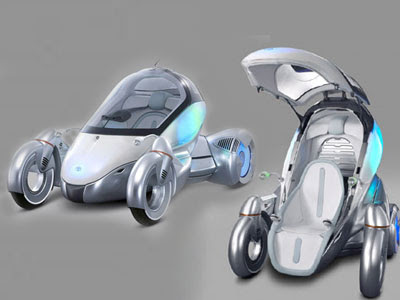
Toyota PM is highly maneuverable thanks to its castor like wheels capable of rotating through 180 degrees. The front wheels are also notable because of their hub-less design.
The futuristic Toyota PM concept from 2003 is a personal transport concept.
The PM's cockpit opens by touching one of the unusual stalk mounted headlights, this then glows green to announce the impending opening of the glass canopy.
Another interesting feature Toyota has built into the PM is its adjustable ride height and attitude. As the PM's speed increases it lowers to the ground to increase stability and improve aerodynamics.
Inside the PM information regarding vehicle performance and the location of other PM's is relayed to the single occupant by a floating virtual display.
Power for the concept comes from an electric motor.
2011 Tesla Electric Sports Cars Roadster 2.5
Tesla launched the new Roadster this week and is delivering to customers now. More than 1,200 current Tesla owners in at least 23 countries have logged over five million electric miles in their Roadsters. CHICHESTER, UK — Tesla Motors (TSLA) will unveil its next-generation sports car to the public this weekend at the Goodwood Festival of Speed. The latest version of revolutionary electric sports car, Tesla Roadster 2.5.

The Festival of Speed is the world's largest motoring garden party - a unique weekend that brings together a heady mix of cars, stars and motor sport 'royalty' to create the largest car culture festival worldwide. Held in the immaculate grounds of Goodwood House, this annual hill-climb extravaganza celebrates all things automotive.
Its two newest Tesla Stores–in Newport Beach, California, and Copenhagen, Denmark–will open with evening receptions. Both will have the Roadster 2.5 on display. The 2011 Tesla Roadster 2.5 features improvements in design and technology, including a new front fascia, rear diffuser, improved seat comfort, sound dampening and an optional large touch screen navigation system with back-up camera.
Inside, the most significant alteration is undoubtedly more comfortable seats, which have larger bolsters and now include a lumbar support system. Interior noise has been reduced in several ways, including new sound-suppressing front fender liners.
Finally, Tesla has further modified the Roadster’s power-control system, adding unspecified hardware to permit “spirited driving” (which we presume means maximum electric power) in exceptionally hot climates.
Prospective customers can see the Tesla Roadster 2.5 at Goodwood or at the London showroom at 49-51 Cheval Place in Knightsbridge, near Harrod’s. Tesla is now delivering this latest version of the car in all Tesla markets in Europe, Asia and North America.


Prospective customers can see the Tesla Roadster 2.5 at Goodwood or at the London showroom at 49-51 Cheval Place in Knightsbridge, near Harrod’s. Tesla is now delivering this latest version of the car in all Tesla markets in Europe, Asia and North America.
Toyota PM Concept Car a personal transport concept

Toyota PM Concept Car
Toyota PM is highly maneuverable thanks to its castor like wheels capable of rotating through 180 degrees. The front wheels are also notable because of their hub-less design.
The futuristic Toyota PM concept from 2003 is a personal transport concept.
The PM's cockpit opens by touching one of the unusual stalk mounted headlights, this then glows green to announce the impending opening of the glass canopy.
Another interesting feature Toyota has built into the PM is its adjustable ride height and attitude. As the PM's speed increases it lowers to the ground to increase stability and improve aerodynamics.
Inside the PM information regarding vehicle performance and the location of other PM's is relayed to the single occupant by a floating virtual display.
Power for the concept comes from an electric motor.
Toyota PM Concept Car a personal transport concept

Toyota PM Concept Car
Toyota PM is highly maneuverable thanks to its castor like wheels capable of rotating through 180 degrees. The front wheels are also notable because of their hub-less design.
The futuristic Toyota PM concept from 2003 is a personal transport concept.
The PM's cockpit opens by touching one of the unusual stalk mounted headlights, this then glows green to announce the impending opening of the glass canopy.
Another interesting feature Toyota has built into the PM is its adjustable ride height and attitude. As the PM's speed increases it lowers to the ground to increase stability and improve aerodynamics.
Inside the PM information regarding vehicle performance and the location of other PM's is relayed to the single occupant by a floating virtual display.
Power for the concept comes from an electric motor.
Toyota PM Concept Car a personal transport concept

Toyota PM Concept Car
Toyota PM is highly maneuverable thanks to its castor like wheels capable of rotating through 180 degrees. The front wheels are also notable because of their hub-less design.
The futuristic Toyota PM concept from 2003 is a personal transport concept.
The PM's cockpit opens by touching one of the unusual stalk mounted headlights, this then glows green to announce the impending opening of the glass canopy.
Another interesting feature Toyota has built into the PM is its adjustable ride height and attitude. As the PM's speed increases it lowers to the ground to increase stability and improve aerodynamics.
Inside the PM information regarding vehicle performance and the location of other PM's is relayed to the single occupant by a floating virtual display.
Power for the concept comes from an electric motor.
Toyota PM Concept Car a personal transport concept

Toyota PM Concept Car
Toyota PM is highly maneuverable thanks to its castor like wheels capable of rotating through 180 degrees. The front wheels are also notable because of their hub-less design.
The futuristic Toyota PM concept from 2003 is a personal transport concept.
The PM's cockpit opens by touching one of the unusual stalk mounted headlights, this then glows green to announce the impending opening of the glass canopy.
Another interesting feature Toyota has built into the PM is its adjustable ride height and attitude. As the PM's speed increases it lowers to the ground to increase stability and improve aerodynamics.
Inside the PM information regarding vehicle performance and the location of other PM's is relayed to the single occupant by a floating virtual display.
Power for the concept comes from an electric motor.
Subscribe to:
Posts (Atom)