Showing posts with label 2010. Show all posts

New Seat Sporty Leon Cupra R

Following a very successful debut at the 2009 Frankfurt Motor Show, the new Seat León Cupra R is about to go on sale. Equipped with a new 265 hp engine, it instantly becomes the brand's most powerful production car to date, earning a special chapter in Seat's history in the process.
New Seat León Cupra R
2010 Seat will unveil its most potent series production model to date, the new Leon Cupra R at next month’s Frankfurt Motor Show (all of you may know already because we revealed this fact back in June in this post). The standard model’s 240-horsepower turbocharged 2.0-liter four-pot is replaced with a 265-horsepower direct injection 2.0 TSI. It is unconfirmed if the 2.0 TSI is the same engine found in the Vw Scirocco R.
New Seat León Cupra R
Seat claims however, that the new four-banger features a new, high-pressure fuel pump injector to satisfy its greater performance demands, while fully complying with strict EU5 emissions standards. As a result, the front-wheel drive only Leon Cupra R slashes the 0 to 100km/h (62mph) sprint from 6.4 seconds (standard Cupra) to 6.1 seconds and top speed climbs from 247 km/h (154mph) to 250 km/h (155mph).
New Seat León Cupra R
A be guiling mix of Latin passion and practicality, this new ‘superSEAT’ remains, of course, the rational choice for ultra-hot hatch buyers who want sporty coupé looks allied to five-door functionality.
New Seat León Cupra R
Boasting a thoroughbred sporty engine, the new Seat León Cupra R features exclusive interior and exterior styling touches which reflect its unique character. The Seat León Cupra R is, simply, an attention-grabber. Its feisty exterior design is mirrored on the inside, too, with a motorsport-inspired look and feel that lets you know this is not just another car.
New Seat León Cupra R
The standing kilometer takes 25.7 seconds and it has a combined fuel economy of 8.1 lt / 100km or 29mpg US / 34.9mpg UK. The range-topping Leon gets the ‘R’ logos on the central grille and at the lower right of the hatch, the right instrument dial and the remote control key. In addition, it also receives 19-inch, five double-spoke wheels shod with 235/35 tires.
New Seat León Cupra R
The larger wheel assembly allowed Seat’s engineers to upgrade the braking system with 17-inch 345 x 30 mm discs at the front and 16 inch 286 x 12 mm at the rear. The interior of the Leon Cupra R gets a pair of racing-style bucket seats in grey alcantara upholstery, LED lighting on the instrument dials, a leather multi-functional steering wheel and an aluminum pedal arrangement.
New Seat León Cupra R
The intercooler fitted to the new engine delivers its superior performance through greater turbo pressure. As on the 240 hp version, the engine set-up includes a new, high-pressure fuel injection pump to satisfy its greater performance demands, and the ratios on the six-speed gearbox have been specifically adapted.
New Seat León Cupra R
The extensive, generous equipment list features Seat's impressive new electronic self-blocking XDS system for excellent handling, as well as a broad array of standard features that provide both top notch safety and exceptional on-board comfort. Undeniably, the focal point of the new Seat León Cupra R is its 265 hp direct injection 2.0 TSI engine. Its main characteristics are its tremendous power, easy torque transmission and fabulous flexibility.
New Seat León Cupra R
UK pricing for the new Leon Cupra R is confirmed at £25,205, with orders books opening at dealers nation wide on Thursday 1 April, and the Spanish sports car is Euro 5 compliant as CO2 emission levels are at just 190 g per Km.
New Seat León Cupra R
Welcoming the UK arrival of the brand’s most extreme model to date, SEAT UK Product Marketing Manager Andy Medcraft said: ‘The engineeringand styling revisions that have gone into the new Leon Cupra R under line our determination to make this exceptional new car a tru e class leader.

2010 Mazda Sport Cars Coupe Shinari Concept Car

Mazda launched the 2010 Shinari sports cars coupe at the Paris Motor Show in early October, a four door concept car that shows the new design. This design as well as to replace the Nagare design. Mazda Shinari Concept represents the profound connection of driver and machine and the beginning of Mazda's latest design theme 'KODO-Soul in Motion'. Shinari exhibits a functional aesthetic that will continue to evolve as Mazda continues to define its next generation of vehicles.
2010 Mazda Sport Cars Coupe Shinari Concept Car
The development of the Shinari Concept was actually a collaboration between three of Mazda’s design centers in Japan, Germany and the United States. Mazda also said it is working to improve the quality level of its interiors for future vehicles. With 2010 Mazda Sport Cars Coupe Shinari Concept Car as the first step, Ikuo Maeda, general manager of Mazda's design division, aims to create original Mazda designs that will be recognized around the world. He summarizes his resolve in the following words:
"My goal is to create designs that people can point to proudly and say, 'This is a Mazda design'. There is no need for Mazda to build cars for people who are only concerned with 'style' and 'trends'. Whether working on sports cars or compact cars, I have always worked to create designs that evoke an emotional response in people and I hope to keep doing the same as I remain fully committed to develop designs for people who love and admire cars. It is my personal belief that the only way to create designs that fundamentally connect with people and to create designs they love, is if the people creating them are absolutely passionate about cars and are willing to make that passion a firm policy for design expression.
The Mazda Shinari is a pure design concept model of a four-door, four-seater sport cars coupe which perfectly expresses the 'KODO - Soul of Motion' design theme in a graceful and carefree form. All of Mazda Shinari Concept's body surfaces appear as if constantly undergoing transformation. There is no static shape to be found, as if the car is in perpetual motion. For instance the subtle control of the angle of the upper surface of the side sill, from the front to the rear, results in a form that suggests a flash of speed along the body of the car. Aerodynamic performance was a major priority for Mazda Shinari Concept, and the centre of the lower sections - on both the front and rear bumpers - are designed to optimize the flow of air along the underbody of the car.
2010 Mazda Sport Cars Coupe Shinari Concept Car 
The principle of 'dedicated driving ergonomics' is further reflected in the car's next generation Human Machine Interface (HMI). The availability of smaller electronic components has allowed Mazda Shinari Concept's designers to create a floating HMI three-dimensional display; a design element that represents the very latest HMI technology . The system offers three distinct modes: 'Business, Pleasure and Sport'.
Yasushi Nakamuta, the chief designer who led the design of the third generation Mazda MX-5, was the first to begin the ideation of the Mazda Shinari Concept: "The challenge for us was to create an innovative new expression for energetic and powerful movement; something that we had never attempted before. We began by developing the design around the image of a predator, as it strikes at its prey, or the stabbing movement in kendo, Japanese fencing, to express the instant where accumulated force is released.
Ikuo Maeda say, "Further, I consider it vitally important to have an awareness of Japanese originality in designing cars for Mazda. This is not merely about incorporating traditional Japanese elements into car design. I believe in reflecting the Japanese spirit in car designs as part of a subconscious practice. So, while I consider where this may lead in the future, my plan is to create cars that will be instantly recognizable as a Mazda, even when viewed at a distance. My ultimate goal is to create a brand presence that car lovers around the world recognize as representing both Mazda originality and Japanese originality. Future Mazda's will move people physically and emotionally - this is 'KODO - Soul of Motion'."

2010 Mazda Sport Cars Coupe Shinari Concept Car 

2010 Touring Superleggera A8GCS Berlinetta Sports Cars Concept

Touring Superleggera A8GCS Berlinetta was revealed in the flesh at the 2010 Geneva Motor Show after being previewed at the Concours d'Elegance. At the Festival Automobile in Paris last month, a panel comprised of designers, car experts and former Formula 1 driver Alain Prost awarded the Maserati A8GCS Berlinetta Touring the most beautiful supercar of the year. Television network Eurosport fielded over one million votes from viewers for the competition. Viewers’ choices included the Bugatti Sport Veyron, BMW 750i and Lotus Evora.
2010 Touring Superleggera A8GCS Berlinetta
Now this is how it's done. The Touring Superleggera A8GCS Berlinetta is a Maserati Gran Turismo rebodied with classic GT proportions and shapes. The result is classically beautiful, like a 1950s Maserati re-interpreted with 21st century technology.
Based on the Maserati Coupé GranSport mechanics, the A8GCS Berlinetta Touring represents the high performance sports car concept, with small dimensions, state-of-the-art constructive technology and perfect stylish synthesis between factory tradition and advanced aesthetic criteria.
Unlike the Bentley Flying Star shooting brake that's also from Touring Superleggera, the Berlinetta isn't destined for a well-heeled car nut. The company created it specifically to showcase its coachbuilding skills. If they have their way, they'll be turning the Maserati Gran Turismo and other exotic cars into vehicles that are even more exclusive, luxurious and personalized.
The new A8GCS Berlinetta Touring has been designed by the young Belgian designer Louis de Fabribeckers, in charge of the Touring styling department. The A8GCS Berlinetta Touring lines are not affected by time or fashion: the car is characterized by a soft aggressiveness originated by the perfect balance between the front end, directly derived from competitions, and the harmonious and fluent flanks reminding of the extraordinary Alfa Romeo, Isotta Fraschini and Lancia Flying Star of the Thirties, an exceptional series created by Touring and still considered the best interpretation of Marinetti and Boccioni’s Futurism.
The Carrozzeria Touring Superleggera style is first expressed through perfecly balanced volumes (reduced front overhang, front central engine and large rear overhang). The result is a dynamic form that doesn’t need a lowered waistline. Moreover, the horizontal development of lines create a natural elegance.
The sporty look of the car is underlined by the combination between bonnet and front grille. An element dashing forward the other volumes. Hence the lateral lines of the body: the lower line ends on the rear wheelarch and the upper line dissolves in the rear end of the car. Together they create a dynamic sail shape, as on Flying Stars.
Of course, also the most successful car design is not enough to make an alive and complete object. It must be combined with excellent dynamic qualities, derived from state-of-the-art technical solutions. For the prototype A8GCS Berlinetta Touring, Carrozzeria Touring Superleggera studied and designeda body in advanced composite materials, able to give the car lightness, structural strenght and performance typical of top granturismo and obviously respecting all international safety and environmental rules. The result is clear: the style protoype A8GCS Berlinetta Touring is able to enter small series production, gaining immediately a top place among the best sports cars.
The A8GCS is a strict two-seater, unlike the car on which it's based which features a 2+2 seating layout. Touring Superleggera have made extensive changes to the car's bodywork while still retaining similar proportions. The styling details like the minimalist chrome trim and classic wire wheels give the car a distinctive retro vibe, while also not being unnecessarily nostalgic.
"We wanted a strong project" - says the Belgian Head of Design of Touring Superleggera, Louis de Fabribeckers - "I drew from the stylistic heritage of Touring the work of surfaces and also this sinusoidal line across the side of the Berlinetta".
The Touring Superleggera A8GCS Berlinetta is 4.2 metres long and only 1.2 metres high. The engineers are aiming for a 1,500 kg (3,307 lb) weight for the finished car - 180 kgs (400 lbs) lighter than the Maserati GranSport.

2010 Sportec SP580 Porsche 997 Turbo Facelift - Porsche Sports Car

The new Sportec 997 Turbo SP580 tuning kit is now available for the Porsche 997. Engineers from Sportec have boosted power from 500 PS (368 kW / 493 hp) to 580 PS (572 hp / 427 kW). If those numbers sound familiar, it is because the Swiss tuning firm developed a package that provided the same horsepower on the last SP580. However, the torque rating is reduced on this model, but is the same as the standard Porsche 997 turbo facelift.
Sportec SP580 Porsche 997 Turbo Facelift
Now, the new model sprints to 100 km/h in just 3.2 seconds, and to 200 km/h in 10.3 seconds. Top speed on the car is 323 km/h. The sprint times are faster than the old SP580, but the previous model topped out at 338 km/h (210 mph).
New forged 20-inch wheels have been developed for the car. However, the aero kit with front spoiler, big rear wing, and side skirts seems to be carried over from the pre-facelift kit.
With the new SP580 Sportec is once more prowling in the stomping ground of the super sports car. True to the sporty understatement Sportec the Porsche 997 turbo is a real leopard in wolf's clothing - this is ensured by the full 580 PS and powerful 650 Nm torque that can be had at just 1.950-5.000 revs.
Thus equipped the Sportec SP580 achieves the standard spring from 0 to 100 km/h in only 3.2 seconds. The occupants of the SP580 are catapulted from 0 to 200 km/h in a breathtaking 10.3 seconds. Only at 323 km/h does the revolution limiter put an end to this flush of speed.
Externally only the powerful Sportec Mono7 forged 20 inch wheels and the completely new aerodynamic package that holds true to the Sportec Motto "more substance, less style", suggest that beholder isn't looking at a mass production vehicle from Zuffenhausen. An aerodynamically optimised front spoiler, discrete side skirts along with a larger tail plane - as an option also to be had in carbon - both technically and optically complete the SP580. And if that wasn't enough the exterior mirrors and the air intakes can be had in matt carbon.
The aluminium pedals and foot supports as well as the bucket seats are all further signs of its sportiness. And for those who like it a little sportier there is a lowering set that brings the chassis around 20 millimetres nearer to the tarmac. For use on the race track Sportec offers a special PASM compatible super sports suspension that can be individually adjusted to suit every purpose and all race track conditions.

2010 Porsche Sports Car 911 Tequipment

Porsche Tequipment has announced four new items for the 2010 Porsche Sport Car Classic 911. The new 2010 Porsche 911 Tequipment list includes sport classic wheels, a PDK steering wheel with gearshift paddles, an Aerokit Cup and a sport design front body panel. The new 2010 Porsche 911 Tequipment wheels come in 11.5 J x 19 ET 50 and are priced at Euro 5,569.20 including VAT. For the cars with tire pressure control the price is 5,866.70 EUR.
Porsche Sports Car 911 Tequipment
The 2010 Porsche 911 Tequipment three-spoke sports steering wheel with gearshift paddles is priced from Euro 940.10 and can be fitted to all versions of the 911, Boxster, Cayman, and Panamera. The 2010 Porsche 911 Tequipment Aerokit Cup is available for the coupe and is priced at Euro 4,522.00.
The Porsche 911 (pronounced as Nine Eleven, German: Neunelfer) is a 2-door sports coupe made by Porsche AG of Stuttgart, Germany. It has a distinctive design, rear engined and with independent rear suspension, an evolution of the swing axle on the Porsche 356.
Porsche Sports Cars Press Release:
Four new retrofit highlights from Dr. Ing. h.c. F. Porsche AG, Stuttgart, are dedicated entirely to the spirit of sporting performance. Particularly the 19-inch Sport Classic wheels in the unmistakable look of Porsche’s legendary Fuchs rims developed especially for the 911 Sport Car Classic built in a production run of just 250 units are an outstanding example of Porsche’s history and a striking design feature of the 911 Carrera.
Re-interpreted in individual style, the wheels in five-spoke design with the rim star painted black, the wheel hump in gloss-lathed finish, and the Porsche logo in colour on the wheel hub, are a genuine eye-catcher. Introduced by Porsche for the first time in 1966, these unique wheels are now making an outstanding come-back. The new wheels measure 8.5 J x 19 ET 55 and come together with tyres in 235/35 ZR 19 (front) and, respectively, 305/30 ZR 19 (rear) on all current all-wheel-drive models of the 911 Carrera and Targa as well as the 911 Turbo at an all-in price per set of Euro 5,569.20 including VAT (cars with tyre pressure control Euro 5,866.70).
Another particularly sporting feature is the three-spoke sports steering wheel with gearshift paddles for the PDK transmission already well known from the new 911 Turbo. Starting immediately, this unique leather steering wheel with gearshift paddles behind the right and left steering wheel spokes carried over from motorsport is available at a price of Euro 940.10 including VAT also for individual retrofitting on all versions of the 911, Boxster, Cayman, and Panamera with PDK and, starting in August 2010, on the new Cayenne with Tiptronic S.
The high-quality shift paddles are naturally made of metal. Through their stretched sickle shape, the gearshift paddles allow the driver to shift gears manually with perfect ease, from a wide range of individual holding positions on the steering wheel. The driver shifts up on the right and down on the left.
The newly developed Aerokit Cup available on all versions of the 911 Carrera Coupé shows a close and direct link to the fastest brand trophy in the world, the Porsche Mobil 1 Supercup. At the front of the car the most outstanding feature is the new apron with its striking trim bars in the centre air intake and the characteristic spoiler lip. At the rear the unique rear lid with the wing fitted in position takes up the highly successful design of the former model. It almost goes without saying that all components have been optimised in Porsche’s wind tunnel to improve both driving behaviour and aerodynamics.
Already available on new cars at a price of Euro 4,968.25 including VAT, the Aerokit Cup may now also be retrofitted on current models of the 911. In this case the price from Porsche Tequipment is Euro 4,522.00 including VAT, plus fitting and paintwork.
While so far the Aerokit with its particularly sporting look was not available to drivers of the 911 Cabriolet and Targa (997), the new, striking Sport Design front apron now closes this gap, with the spoiler lip matched aerodynamically to the regular rear spoiler. Naturally, the new front panel also fits on all other versions of the 911 Carrera and 911 Targa in the 997 model series. Finished in the same colour as the car itself, the front apron in Sport Design blends harmoniously with the overall contours and silhouette of the 911.
The Aerokit retails on new cars at a price of Euro 2,368.10 including VAT and is available from Porsche Exclusive. It may also be retrofitted individually by Porsche Tequipment at a price of Euro 2,159.85 including VAT, plus the cost of fitting and paintwork.

2010 Bufori Geneva Luxury Sports Saloon

Bufori is one of those odd little manufacturers which has somehow managed to survive and prosper in an environment littered with the carcasses of bankrupt, stillborn or struggling small volume car makers.
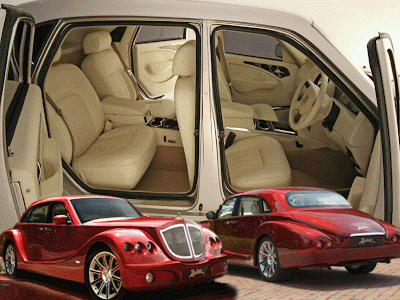
2010 Bufori Geneva
Quite how it's managed this feat is a mystery. Although the main advantages it has over the competition is a unique sense of old-world style which is difficult to find from other makers, and the fact it's one of the few low volume car producers to be located in the far east - Malaysia to be exact (also home of Lotus' parent company Proton).
2010 Bufori Geneva
Today, BUFORI Motor Car Company (M) Sdn Bhd has unveiled, its most eagerly awaited model at the 80th Geneva International Motor Show. The car was officially presented by BUFORI Motor Car Company’s Founders at a press conference during the prestigious Swiss Motor Show. At the same occasion, the Luxury Saloon, which was previously code name Bufori MKVI, was officially named “Bufori Geneva”.
2010 Bufori Geneva
Bufori Motor Company presented at the Geneva Motor Show its most awaited model, the Bufori Geneva. The model was officially launched by the founders themselves Bufori, Anthony Khouri, George and Gerry Khouri Khouri at a press conference during the Geneva Motor Show. In the Motor Show, the company unveiled the name, formerly known as Bufori MKVI.
2010 Bufori Geneva
"We decided to name the new model Bufori as the city where he was released, as this marks a historic event for the company. Let me also pay tribute to the 80 year history of the Motor Show."
2010 Bufori Geneva
Made of Hybrid Carbon Fibre and Kevlar which is infused with Vinylester resin, the BUFORI Geneva features classic design elements with long running boards, integrated bi-xenon headlamps, and LED rear lights. The Bufori Geneva is powered by a thoroughbred 6.1-litre V8 engine, producing an impressive 430hp and 586Nm of torque.
2010 Bufori Geneva
The acceleration from 0-100 kph is under 6 seconds with a top speed of more than 260kph (estimated figures). Besides, an optional supercharger that increases the performance of the engine to 560hp and 690Nm of torque is also available.
2010 Bufori Geneva
The interior design team of the company has endeavored to create a relaxing environment, combining traditional and modern materials such as leather and wood. The center console is completely customized to the needs of most demanding owners. Some of these features include a set of tea with boiling water and a sink, coffee maker or even an ice box. An integrated thermal box and mini bar and champagne glasses, a security safe for valuables or a cigar humidor.
2010 Bufori Geneva
To provide a more comfortable and safer handling, the model will have ABS, electronic brake force, brake assistance, traction control, steering angle control and cruise control.
2010 Bufori Geneva
You will have a thermal cameras in the bumpers. When activated, you can recognize pedestrians and objects up to 300 feet away and displays them on screen. Bufori Geneva production is scheduled to begin in June 2010 with the first units shipped before year end.
Related Posts Plugin for WordPress, Blogger...