2012 Ferrari FF Reviews & Pictures. 2012 Ferrari FF – Ferrari initials of four (four seats and four wheel drive/4WD) – open a whole new concept in GT sports car. A decisive break with the past, the new car represents both the evolution of a revolution. This new V12 combines a whole new level very [...]
Find here the development of famous cars in the world. you can find the latest designs, models and matters relating to otomotivnya. how the car companies from different continents that have been known to produce and introduce their products
2012 Ferrari FF Reviews & Pictures
2012 Ferrari FF Reviews & Pictures. 2012 Ferrari FF – Ferrari initials of four (four seats and four wheel drive/4WD) – open a whole new concept in GT sports car. A decisive break with the past, the new car represents both the evolution of a revolution. This new V12 combines a whole new level very [...]
Modern Sports Car Pontiac Solstice Coupe

The making of a coupe
It is a modern sports car with classic lines. The roofline has a "fastback" shape with stylized "rails" that run from the front of the roof to the rear, culminating in a stylish and functional ducktail-style rear spoiler.
The coupe's roof is fixed aft of the B-pillars, with side windows and a rear liftglass for access to the cargo area. The roof panel is easily removed from the passenger compartment, and an optional soft roof cover stores in the cargo area.
The sleek lines of the new roof give the car a fresh appearance, only minimal changes were made to the body structure - it's a great example of building on an already solid foundation.

The Lightweight structure
The roof's structure was strengthened with additional support elements, including an aluminum roof bow attached with aluminum brackets. The bow and brackets are stiff, low in mass, a design feature that pervades the coupe's overall construction. The roof includes a lightweight sheet molding compound cover affixed to a rigid aluminum frame for additional lightweight support. A lightweight magnesium roof panel frame weighs just 31 pounds (14.2 kg) and can be removed by one person. The cover is also made of sheet molding compound.
The Interior additions
Much of the coupe's interior remains the same as that of the convertible. However, the area behind the seats was redesigned for easy access to the cargo area, and a storage tray was mounted directly behind the headrests.
Removing the folding-top mechanism made way for a new, flat cargo floor and several storage compartments. The cargo area's covered bins provide secure storage for smaller items. Cargo tie-down hooks help secure irregularly shaped items.
Modern Sports Car Pontiac Solstice Coupe

The making of a coupe
It is a modern sports car with classic lines. The roofline has a "fastback" shape with stylized "rails" that run from the front of the roof to the rear, culminating in a stylish and functional ducktail-style rear spoiler.
The coupe's roof is fixed aft of the B-pillars, with side windows and a rear liftglass for access to the cargo area. The roof panel is easily removed from the passenger compartment, and an optional soft roof cover stores in the cargo area.
The sleek lines of the new roof give the car a fresh appearance, only minimal changes were made to the body structure - it's a great example of building on an already solid foundation.

The Lightweight structure
The roof's structure was strengthened with additional support elements, including an aluminum roof bow attached with aluminum brackets. The bow and brackets are stiff, low in mass, a design feature that pervades the coupe's overall construction. The roof includes a lightweight sheet molding compound cover affixed to a rigid aluminum frame for additional lightweight support. A lightweight magnesium roof panel frame weighs just 31 pounds (14.2 kg) and can be removed by one person. The cover is also made of sheet molding compound.
The Interior additions
Much of the coupe's interior remains the same as that of the convertible. However, the area behind the seats was redesigned for easy access to the cargo area, and a storage tray was mounted directly behind the headrests.
Removing the folding-top mechanism made way for a new, flat cargo floor and several storage compartments. The cargo area's covered bins provide secure storage for smaller items. Cargo tie-down hooks help secure irregularly shaped items.
The Toyota FT-HS Hybrid Sports Car

The FT-HS incorporates hybrid capability while maintaining sports car essentials, such as a sleek profile, lightweight aero-dynamic materials, and an advanced high-output powertrain for revolutionary acceleration and optimal performance. This 21st century sports car is fun-to-drive with eco-friendly benefits such as ultra-low emissions and fuel efficiency. The FT-HS appeals to an emerging buyer who grew up eco-conscious and perceives technology as a necessity, not a luxury.
This two-plus-two concept is a front-engine, rear-drive sports car with a projected zero-to-60 acceleration in the four-second range. A powerful V6, 3.5L-engine is coupled with a 21st century sports hybrid system with a target power output of approximately 400-horsepower. At a mid-priced market position, FT-HS would be a true "attainable exotic" with 21st Century performance.
FT-HS expresses the core values of a Toyota Brand design strategy that combines two key elements: J-Factor and Vibrant Clarity. J-Factor refers to the local and global acceptance of Japanese-inspired design and cultural sensibilities.
The exterior design was led by Calty designer, Alex Shen. From a design perspective, the theme of the FT-HS achieves sleek, taut surfaces in its exterior features - especially in the doors and body style. The front and rear have been sculpted to remove mass around key functional components. Freeform geometrics define the integration of fluid surfaces contrasting hard-edge "Aero-Corners" which promote smooth airflow and reduce turbulence.
The roof has a distinctive scooped-out section designed to reduce aerodynamic drag and provide head room at the key areas. Made from carbon fiber Kevlar, the roof retracts so that the roof panel and back window pivot fluidly in a downward motion to stow in the rear seat space.
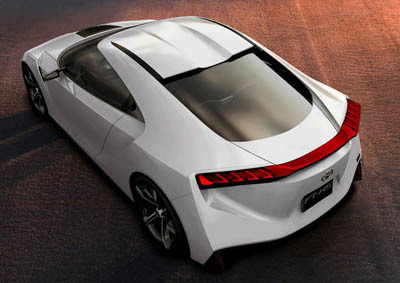
The vehicle's triangular profile has a floating "C" pillar, aero corners, a full upper-body pan, and innovative open top. A hood features a scalloped channel, exposing the hybrid engine. Integrated component architecture can be seen in the aerospace-inspired lighting. The tail lamp unit spans the entire rear, and has an integrated retractable spoiler. Light-emitting diode (LED) clusters are located in the headlamps and the wing for energy-efficiency and decreased heat loss. Other exterior features include a speed-activated wing that elevates at high speed for additional stability and traction. The rear showcases a carbon fiber lower diffuser with integrated wide exhaust and carbon fiber wheels.

The driver-oriented interior was created by Calty designer, William Chergosky and exudes sleekness, technology, and performance. The lean skeletal look is achieved with exposed cross-car architecture and high-tech materials such as carbon fiber, and titanium. FT-HS' interior features create a dedicated driver's cockpit which include subtractive mass expressions such as cross-car instrument panel structure and delta wing driver pod.
By eliminating the "B" pillar and creating a suspended "C" pillar, the minimalist style works in conjunction with subtractive mass. An integrated instrument panel surrounds the driver, creating an enclosed pod effect. Armrests flow seamlessly into the door and surrounding interior.
Seating is optimized for a lightweight appearance and function: the seating accommodates four and then coverts to a two-seater when the roof retracts. The passenger-seat area is open with a simple exposed airbag on the cross-car beam.A telescoping hub-less steering wheel incorporates semi-automatic paddle shifters and allows the meter to be shifted forward in order to shorten the driver's focus-time between the road and meter, and ultimately enhance driver focus.
Toyota FT-HS Concept Vehicle Preliminary Specifications Drivetrain
3.5 Liter V6 hybrid electric
DIMENSIONS (inches)
* Overall Length: 170.27
* Overall Width: 73.23
* Overall Height: 50.79
* Wheelbase: 104.33
Wheels: Carbon Fiber
Tire Sizes: Front 245/35R21 Rear 285/30R21
The Toyota FT-HS Hybrid Sports Car

The FT-HS incorporates hybrid capability while maintaining sports car essentials, such as a sleek profile, lightweight aero-dynamic materials, and an advanced high-output powertrain for revolutionary acceleration and optimal performance. This 21st century sports car is fun-to-drive with eco-friendly benefits such as ultra-low emissions and fuel efficiency. The FT-HS appeals to an emerging buyer who grew up eco-conscious and perceives technology as a necessity, not a luxury.
This two-plus-two concept is a front-engine, rear-drive sports car with a projected zero-to-60 acceleration in the four-second range. A powerful V6, 3.5L-engine is coupled with a 21st century sports hybrid system with a target power output of approximately 400-horsepower. At a mid-priced market position, FT-HS would be a true "attainable exotic" with 21st Century performance.
FT-HS expresses the core values of a Toyota Brand design strategy that combines two key elements: J-Factor and Vibrant Clarity. J-Factor refers to the local and global acceptance of Japanese-inspired design and cultural sensibilities.
The exterior design was led by Calty designer, Alex Shen. From a design perspective, the theme of the FT-HS achieves sleek, taut surfaces in its exterior features - especially in the doors and body style. The front and rear have been sculpted to remove mass around key functional components. Freeform geometrics define the integration of fluid surfaces contrasting hard-edge "Aero-Corners" which promote smooth airflow and reduce turbulence.
The roof has a distinctive scooped-out section designed to reduce aerodynamic drag and provide head room at the key areas. Made from carbon fiber Kevlar, the roof retracts so that the roof panel and back window pivot fluidly in a downward motion to stow in the rear seat space.

The vehicle's triangular profile has a floating "C" pillar, aero corners, a full upper-body pan, and innovative open top. A hood features a scalloped channel, exposing the hybrid engine. Integrated component architecture can be seen in the aerospace-inspired lighting. The tail lamp unit spans the entire rear, and has an integrated retractable spoiler. Light-emitting diode (LED) clusters are located in the headlamps and the wing for energy-efficiency and decreased heat loss. Other exterior features include a speed-activated wing that elevates at high speed for additional stability and traction. The rear showcases a carbon fiber lower diffuser with integrated wide exhaust and carbon fiber wheels.

The driver-oriented interior was created by Calty designer, William Chergosky and exudes sleekness, technology, and performance. The lean skeletal look is achieved with exposed cross-car architecture and high-tech materials such as carbon fiber, and titanium. FT-HS' interior features create a dedicated driver's cockpit which include subtractive mass expressions such as cross-car instrument panel structure and delta wing driver pod.
By eliminating the "B" pillar and creating a suspended "C" pillar, the minimalist style works in conjunction with subtractive mass. An integrated instrument panel surrounds the driver, creating an enclosed pod effect. Armrests flow seamlessly into the door and surrounding interior.
Seating is optimized for a lightweight appearance and function: the seating accommodates four and then coverts to a two-seater when the roof retracts. The passenger-seat area is open with a simple exposed airbag on the cross-car beam.A telescoping hub-less steering wheel incorporates semi-automatic paddle shifters and allows the meter to be shifted forward in order to shorten the driver's focus-time between the road and meter, and ultimately enhance driver focus.
Toyota FT-HS Concept Vehicle Preliminary Specifications Drivetrain
3.5 Liter V6 hybrid electric
DIMENSIONS (inches)
* Overall Length: 170.27
* Overall Width: 73.23
* Overall Height: 50.79
* Wheelbase: 104.33
Wheels: Carbon Fiber
Tire Sizes: Front 245/35R21 Rear 285/30R21
A History of Sports Cars


To begin with motor vehicles were built for more functional than aesthetically pleasing reasons and their ability to carry both people and heavy loads is what drove the designers and manufacturers forward. Humans though have an eye for beauty and a thirst for power and speed, combining these attributes the birth of the sports cars was inevitable.
As new developments occurred in the early motor industry a small number of designers, builders and drivers pushed the motor car to its limits on race tracks to test its abilities against other manufacturers vehicles. These races fuelled the next generation of cars and drivers. As engines became more powerful the ability to race these machines began to push the designs and needs to new levels this quite often was at the expense of someone's life.
Big powerful engines were placed into fragile frames and pushed to the limit often with dire consequences to drivers and spectators. But humans have a need to go faster and faster and this drove these brave and quite often reckless early pioneers to design better and more powerful machines and this began the start of the new age of the modern motor car. Safety was usually an after thought if it came up at all, the main focus was pushing the machines and drivers to their limits and beyond if possible. The engines power output quickly out grew the motor cars ability to handle these increases and the designers had to rethink the chassis and suspensions limitations. As with in the aircraft industry the designs of planes and engines regularly changed along with the abilities and reliability of the aircraft, the motor cars began to evolve along the same lines with new ideas and breakthroughs in technologies incorporating aerodynamics to help reduce drag and stronger building materials for chassis and bodywork.
Developing test vehicles purely for racing was the beginning of what we now class as the sports car. After the Second World War a new breed of sports car began to emerge. The once very high-priced and hard to obtain race bred cars that only the most wealthy and enthusiastic owners could secure began to evolve into a more accessible vehicle with the additional comforts and road functionalities, and what was even more important, a more affordable price tag making them more accessible to the average owner and driver. The sports cars had taken their first steps from the exclusive domain to main stream availability. Over the next few years as advancements were made on and off the racing circuit designs began their slow transformation into the popular modern shapes of today's models. Many famous names have added their own distinctions to the sports car moulds and most can be easily identified by pure shape alone even today.
A History of Sports Cars


To begin with motor vehicles were built for more functional than aesthetically pleasing reasons and their ability to carry both people and heavy loads is what drove the designers and manufacturers forward. Humans though have an eye for beauty and a thirst for power and speed, combining these attributes the birth of the sports cars was inevitable.
As new developments occurred in the early motor industry a small number of designers, builders and drivers pushed the motor car to its limits on race tracks to test its abilities against other manufacturers vehicles. These races fuelled the next generation of cars and drivers. As engines became more powerful the ability to race these machines began to push the designs and needs to new levels this quite often was at the expense of someone's life.
Big powerful engines were placed into fragile frames and pushed to the limit often with dire consequences to drivers and spectators. But humans have a need to go faster and faster and this drove these brave and quite often reckless early pioneers to design better and more powerful machines and this began the start of the new age of the modern motor car. Safety was usually an after thought if it came up at all, the main focus was pushing the machines and drivers to their limits and beyond if possible. The engines power output quickly out grew the motor cars ability to handle these increases and the designers had to rethink the chassis and suspensions limitations. As with in the aircraft industry the designs of planes and engines regularly changed along with the abilities and reliability of the aircraft, the motor cars began to evolve along the same lines with new ideas and breakthroughs in technologies incorporating aerodynamics to help reduce drag and stronger building materials for chassis and bodywork.
Developing test vehicles purely for racing was the beginning of what we now class as the sports car. After the Second World War a new breed of sports car began to emerge. The once very high-priced and hard to obtain race bred cars that only the most wealthy and enthusiastic owners could secure began to evolve into a more accessible vehicle with the additional comforts and road functionalities, and what was even more important, a more affordable price tag making them more accessible to the average owner and driver. The sports cars had taken their first steps from the exclusive domain to main stream availability. Over the next few years as advancements were made on and off the racing circuit designs began their slow transformation into the popular modern shapes of today's models. Many famous names have added their own distinctions to the sports car moulds and most can be easily identified by pure shape alone even today.


